


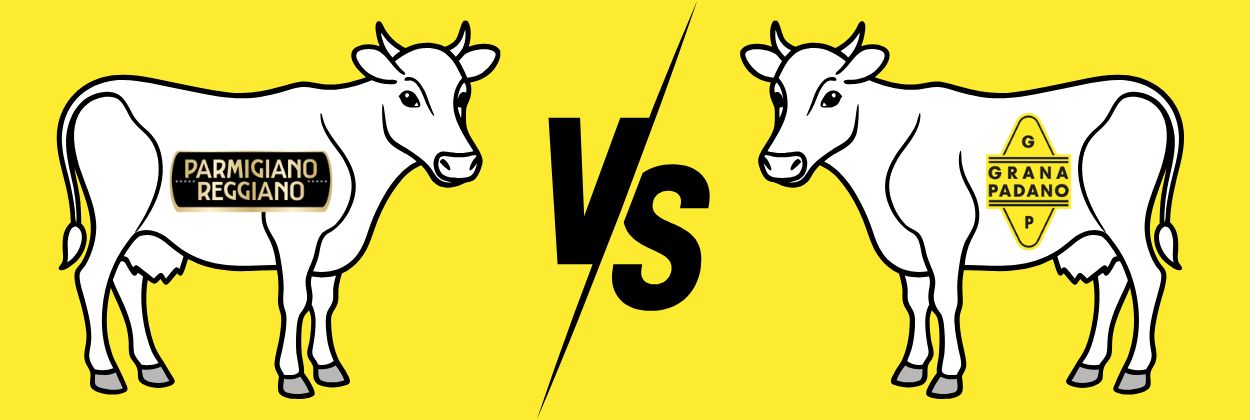
In the international trade of Italian cheese, Parmigiano Reggiano and Grana Padano represent two fundamental pillars of Made in Italy. Both are PDO (Protected Designation of Origin) cheeses, both are widely recognised worldwide, and both enjoy strong demand in international markets.
Yet, they are not interchangeable.
For companies involved in food export, choosing between Parmigiano Reggiano and Grana Padano is not simply a matter of taste or price, but a strategic commercial decision that directly affects positioning, competitiveness and long-term sustainability.
This article analyses the real differences, key export markets, and practical criteria for choosing the right product for international trade, supported by updated market data.
Two PDO cheeses, two distinct identities
Although Parmigiano Reggiano and Grana Padano both hold PDO status, they are governed by different production specifications, which influence their commercial profile and market perception.
Parmigiano Reggiano: premium positioning and brand value
Parmigiano Reggiano is produced in a clearly defined geographical area under a particularly strict production code. Over time, this has built:
- a strong territorial identity
- high brand recognition
- a premium positioning in international markets
In many countries, Parmigiano Reggiano is perceived as the benchmark of Italian hard cheese, often associated with authenticity, long ageing and tradition.
Grana Padano: flexibility and global reach
Grana Padano is produced across a wider geographical area and follows a more flexible production framework. This allows:
- greater price competitiveness
- adaptability to different sales channels
- strong performance in high-volume markets
These characteristics have made Grana Padano the most exported Italian PDO cheese by volume worldwide.
Production and export figures (2024–2025)
Market data plays a key role in understanding how and where each cheese performs internationally.
Parmigiano Reggiano: export-driven growth
In 2024, Parmigiano Reggiano achieved a record global turnover of €3.2 billion, with:
- total sales growth of approximately +9%
- export growth of +13.7%
- exports accounting for nearly 49% of total sales
(Official source (Consortium data): https://www.parmigianoreggiano.com/en/news/economic-results-2024)
In 2025, for the first time in its history, exports exceeded domestic sales, reaching 53.2% of total volume (49,030 tonnes). The strongest growth was recorded in the United States, United Kingdom and Canada. https://www.gdoweek.it/parmigiano-reggiano-export-surpasses-domestic-market/
This milestone clearly shows that Parmigiano Reggiano has become an increasingly export-oriented product.
Grana Padano: volume leadership in global markets
Grana Padano continues to strengthen its position as the largest Italian PDO cheese by production and export volume.
In 2024:
- total production exceeded 5.6 million wheels
- exports reached over 2.68 million wheels
- exports accounted for more than 50% of total production
(International market source: https://www.esmmagazine.com/fresh-produce/italian-hard-cheese-exports-set-new-record-in-2024-286924)
These figures confirm Grana Padano as a key product for volume-driven export strategies, especially within the EU and North American markets.
Export markets: where each cheese performs best
Parmigiano Reggiano: mature and premium markets
Parmigiano Reggiano performs particularly well in:
- Western Europe
- United States
- Canada
- Japan and other high-gastronomy markets
It is mainly positioned in:
- specialty retail
- mid-to-high-end foodservice
- consumer segments focused on origin, ageing and authenticity
In these markets, perceived value often outweighs price sensitivity.
Grana Padano: retail, foodservice and broad penetration
Grana Padano is highly competitive in:
- European Union (Germany is the leading export destination)
- North America
- emerging high-consumption markets
It is widely used in:
- large-scale retail (GDO)
- foodservice
- private label
- food processing
Here, success is driven by quality consistency, reliable supply and price positioning.
Export selection criteria: what really matters
Choosing between Parmigiano Reggiano and Grana Padano does not mean deciding which product is “better”, but which is more suitable for a specific commercial strategy.
1. Sales channel
- Premium retail → Parmigiano Reggiano
- Retail chains & foodservice → Grana Padano
- Mixed channels → combined strategy
2. Destination market
Each market has a different perception of Italian cheese. In some countries, origin and denomination are decisive; in others, price-to-quality ratio plays a bigger role.
3. Ageing, format and packaging
There is no single Parmigiano or Grana Padano. Different ageing periods, formats and packaging options significantly affect:
- product rotation
- pricing strategy
- channel suitability
4. Brand coherence
The cheese must align with:
- the distributor’s positioning
- the target consumer
- the overall brand narrative
A strategic choice, not a binary one
One of the most common mistakes in export planning is assuming that Parmigiano Reggiano and Grana Padano are substitutable products.
In reality:
- they serve different market needs
- they can coexist within the same product portfolio
- they support different commercial objectives
The key differentiator is market knowledge, not just the name on the label.
Conclusion
Parmigiano Reggiano and Grana Padano are both powerful ambassadors of Made in Italy worldwide. Knowing how to position and select them correctly is what turns a one-off sale into a stable and sustainable international presence.