


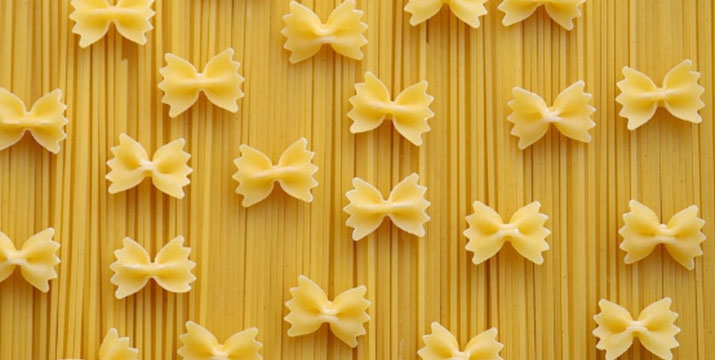
Pasta is the most appreciated first course in the world, symbol of Italian culture and national pride. This is why Italians care so much that it is prepared properly. It is more than food, it is an element of union shared throughout Italy: it is an integral part of the life and popular culture (simple but traditional) of all Italians, not only of their cuisine, but of their very essence. Pasta means tradition, the symbol of Italian cuisine always and forever.
Origins of pasta
The origins of pasta are very ancient. It all began when man abandoned nomadic life, learned to sow and harvest, and became a farmer. It is at that time that the history of man merges and intertwines with that of wheat, and with wheat begins the history of pasta. From harvest to harvest, from generation to generation, man learned to work wheat better and better by grinding it, mixing it with water, rolling it into thin doughs and cooking it on hot stone.
The first indication of the existence of something similar to pasta dates back to the first millennium BC, and is attributable to Greek civilization.
Pasta in Italy
The Greek word laganon was used to indicate a large, flat sheet of pasta cut into strips. From laganon derives the Latin laganum, which Cicero mentions in his writings. Lagane and pasta sheets conquered the empire and, as often happens, each people adapted the novelties to their own experiences.
The first two certain dates in the history of pasta in Italy are: 1154, when in a sort of tourist guide ante litteram the Arab geographer Al-Idrin mentions "a flour food in the form of threads", called triyah (from Arabic itrija, which survives in the modern language and derives from the root tari = moist, fresh), which was packaged in Palermo and exported in barrels throughout the peninsula; and 1279, when the Genoese notary Ugolino Scarpa drew up the inventory of objects left by a deceased sailor, among which also appears a "bariscela plena de macaronis". We know that Marco Polo returned from China in 1295: thus the legend that he introduced pasta (the one known in China, moreover, had little to do with the durum wheat one typical of our country) to Italy is debunked.
Drying of pasta
It was the desert Arabs who first dried pasta to destine it for long preservation, since in their wanderings they did not have enough water to make fresh pasta every day. Thus were born small cylinders of pasta pierced in the middle to allow rapid drying. When? The oldest document is the cookbook of 'Ibn 'al Mibrad (9th century), where a very common dish among Bedouin and Berber tribes appears, still known today in Syria and Lebanon: it is rista, that is, dried macaroni seasoned in various ways, but especially with lentils.
Drying allowed pasta to face long sea journeys, for which Genoese merchants specialized in particular, usually and locally called fidellari, since fidelli was the name given to spaghetti in this area of northwestern Italy, while in the rest of Italy they continued to be called vermicelli, the same ones that later would take the name of spaghetti. Thus Liguria became a place of production of enormous quantities of dried pasta, while Emilia-Romagna, Lombardy, Basilicata and Veneto remained tied to the use of fresh pasta that still persists today.
Middle Ages - the first Italian shops producing pasta
It was in the Middle Ages that the first Italian shops for the professional preparation of pasta arose, which from Southern Italy, steeped in Arab culture, moved towards the rest of the peninsula, North Africa, the Middle East, Spanish Levant and the rest of Europe. Already in the mid-thirteenth century, large pasta factories were installed especially in Naples, Genoa and Salerno, cities that would then have great participation in the evolution and success of pasta. Later they also opened in Puglia and Tuscany and in the fourteenth century the first Corporations of Italian Pasta Makers were established, controlled and regulated by the Pope, whose Vatican bulls regulated shop practices, and established between 1300 and 1400 that, especially in the city of Rome, there could not be less than 50 meters between one pasta shop and another, to avoid disputes between merchants; documents that clearly showed how the pasta-making art was enormously widespread throughout Italy of that era.
What does pasta contain?
Although the manufacturing process has changed enormously over the years, the product has always remained the same simple mixture of durum wheat semolina and water. While fresh pasta is also prepared with soft wheat flour, for dried pasta in Italy exclusively durum wheat semolina is used. Durum wheat and soft wheat are two varieties of the most widespread cereal in the world: wheat. In Italy both are cultivated and the difference is very important. Italian law also notes this, establishing that to produce dried pasta only durum wheat semolina can be used. This is because durum wheat semolina contains that tenacious gluten that allows dried pasta to hold cooking and remain al dente.
How much pasta does Italy produce?
Every year in Italy about 3.3 million tons of pasta are produced. Excluding small artisan pasta factories, there are more than 139 pasta factories on Italian territory: 58 in Northern Italy, 30 in Central Italy, more than 50 in Southern Italy. The regions where there is greater pasta production at national level are:
- Campania (particularly the cities and provinces of Naples and Salerno)
- Emilia Romagna (particularly the cities and provinces of Bologna and Parma)
- Liguria (particularly the city and provinces of Genoa)
- Tuscany
- Lombardy
Gluten-free pasta
Today, more and more people suffer from food intolerances. For this reason, special pastas such as gluten-free pasta are very popular and widespread throughout the world. Types of pasta designed both for celiacs and for those who want to vary their diet with products different from classic durum wheat semolina pasta. In fact, it is important to introduce alternative cereals to wheat in your diet to make it richer and less monotonous. The alternatives to wheat pasta are now very numerous: on the market you can find rice, corn, buckwheat, pea, millet, quinoa, amaranth, sorghum, oat pasta. Zero additives: just flour, water and lots of flavor.
Pasta varieties
There are many varieties of pasta that can be found on the market today, which differ in shapes, colors, flavors as well as production type. According to shape, they are distinguished into the following categories:
- long pasta
- round section such as vermicelli, spaghetti, ...
- hollow section such as bucatini, ziti, ...
- rectangular or lens section such as trenette, linguine, …
- wide thickness such as lasagne, reginette, …
- pasta in nests or skeins
- wide thickness such as pappardelle, tagliatelle, …
- reduced thickness such as capellini, tagliolini, fettuccine, …
- short pasta
- long such as rigatoni, sedani, fusilli, penne, garganelli, …
- medium such as pipe, conchiglie, orecchiette, ...
- small pasta, pastina for soups such as quadrucci, stelline, …
- filled pasta such as tortellini, ravioli, agnolotti, cannelloni, …
- fantasy pasta in very varied and unusual shapes
Based on the type of surface, pasta is further divided into two categories:
- smooth, appreciated for lightness
- ridged, appreciated for the ability to retain sauces
Furthermore, by adding particular ingredients to the dough it is possible to give the various formats different colors:
- red with boiled and blended beets or tomato concentrate
- orange with cooked and blended carrots or pumpkin
- yellow with saffron or curry dissolved in a little warm water
- blue with spirulina algae
- green with boiled spinach, basil or parsley just blanched and blended
- brown with unsweetened cocoa
- purple with blueberry juice and pulp
- black with squid ink
Pasta aromas
The flavor of a pasta is given by a skillful combination of flours and aromas. In addition to soft wheat flour and durum wheat semolina which are the most used, many others can be processed such as spelt, rice, barley, chestnut, buckwheat, etc. Each of these flours will confer its own character, affecting both taste and consistency. In the choice of flours, it is of fundamental importance to keep in mind their gluten content because it affects the hold of the dough and the resistance to cooking which increase proportionally to it. During cooking, in fact, the two proteins gliadin and glutenin contained in the flours bind to water forming a kind of network. The proteins of semolina form a tight mesh network trapping the starch that would make the pasta sticky; those of soft wheat flour form a wide mesh network that more difficultly retains the starch of the pasta which will tend to overcook.
The term aromas includes all the ingredients that can be mixed into the dough making it tastier. First in importance is the egg because, in addition to enriching the flavor, it has the ability to bind to the particles of flour and other ingredients making the dough viscous, easier to form and more consistent after cooking; immediately after, extra virgin olive oil which gives the dough elasticity and plasticity; third is salt which helps strengthen the gluten mesh, while stiffening the dough a bit. Beyond these there is a long series of foods as varied as imagination: breadcrumbs, cheeses, various herbs dry or fresh ground to powder, spices, chili pepper, ...
5 tips for consuming pasta
Pasta is a food widespread throughout the world. Outside of Italy, however, our culinary rituals are distorted, and here we find ourselves faced with pasta seasoned with ketchup and perhaps placed next to a steak as a side dish. Here then are some simple tips to help foreigners who want to avoid mistakes in pasta preparation.
- Use a fairly large saucepan or pot with high walls so that the pasta has enough water available to rehydrate (for every 100 g of dried pasta, 1 liter of water is needed).
- Immerse the pasta all at once and stir it immediately, this will prevent it from sticking.
- Long pasta, in particular, should never be broken, but immersed gradually in the pot as it softens. Only when the water has reached boiling point add twelve grams of coarse cooking salt per liter of water and wait, before throwing in the pasta, for it to dissolve perfectly and for the water to return to boiling. Cook uncovered over a fairly lively flame, stirring frequently.
- Cooking time depends on the size and shape of the pasta. For example, pasta with a ridged surface will have longer cooking times than pasta with a smooth surface. The most important thing for us Italians is to cook it "al dente": because it should not taste either too raw or too cooked. Therefore it is always best to follow the manufacturer's notes on the package and taste the pasta a moment before draining it. As soon as the pasta has reached the right cooking point, pour a ladle of cold water into the pot to immediately stop cooking, then drain it.
- When serving it, it is good practice to always heat the plate (unless it is a pasta dish to be served cold) with boiling water and dry it well before pouring the pasta. Finally, season the pasta with part of the sauce and serve the rest, very hot, in a sauce boat.
4 Italian ways to serve pasta:
In Italy, pasta is served mainly in four ways:
- Pasta asciutta (or pastasciutta) - boiled pasta served hot, accompanied by sauces of various kinds
- Pasta in brodo - small pasta, boiled in meat or vegetable broth and served hot mainly at dinner time
- Pasta al forno - pasta cooked in the oven such as lasagna, cannelloni, etc.
- Pasta fredda - pasta previously cooked and dressed with fresh vegetables and pickles and then cooled, ideal on hot summer days.
Condiments are garments of color and flavor tailored specifically for the type of pasta you want to season. They include very different preparations, both for components and cooking techniques: sauces and ragù, béchamels and vellutate, cheese fondues and cream reductions, raw vegetables, meat or vegetable broths, etc. The undisputed protagonist among all condiments is the tomato which, becoming part of numerous preparations, has contributed to the success of the most famous dish of Italian cuisine and is now considered the "classic" accompaniment. Whatever the seasoning, it must be justly creamy, not watery or too dry. To this end, it is necessary to regulate the pasta shape, more or less capable of retaining and absorbing the sauce, in order to choose the appropriate technique and cooking time.
How many calories in a portion of pasta?
How to say no to a good plate of pasta? Put aside the guilt, because it is not true that pasta makes you fat. The widespread thought that pasta makes you fat is a "myth" to be debunked. An average portion, equal to 70-80 grams, contains about 300-350 calories and zero fat, so it is absolutely a healthy and wholesome food.
The difference is given by the quantity consumed and obviously by the type of seasoning added. You could eat pasta every day, for lunch and dinner: but only if you stick to the indicated order of 70-80 grams, and season it with vegetables and a spoonful of extra virgin olive oil, raw, you will not gain weight. The advice is to eat it for lunch, combining vegetables and protein sources such as legumes or fish, and in the evening prepare a second course with a side dish and a piece of bread.
Italian rules for consuming pasta:
Finally, let's review the most frequent mistakes made abroad in pasta preparation, providing some simple indications to avoid them.
- It is eaten exclusively with a fork, it is not cut with a knife and it is not rolled with a spoon.
- Italians never rinse it with cold water after draining it.
- The sauce must be immediately added to the pasta as soon as it is drained and mixed, and not put by spoonfuls on top of unseasoned pasta.
- Another delicate topic is the use of cheese on pasta. Italians don't use Emmental or Gruyere, but only Parmesan or Grana and, if the recipe allows, salted pecorino. Absolutely to be avoided on pasta with fish or seafood.
- Pasta is a complete dish in itself, the first course par excellence. Never use it as an accompaniment to another dish, such as steak or chicken.
- Ketchup should not be used to season pasta; if you have nothing in the fridge, a drizzle of extra-virgin olive oil and a sprinkling of Parmigiano Reggiano or Grana Padano will suffice.
- Carbonara is one of the most "distorted" recipes abroad. Beaten egg, pancetta, parmesan and pepper in abundance are the only ingredients allowed by the original recipe.