


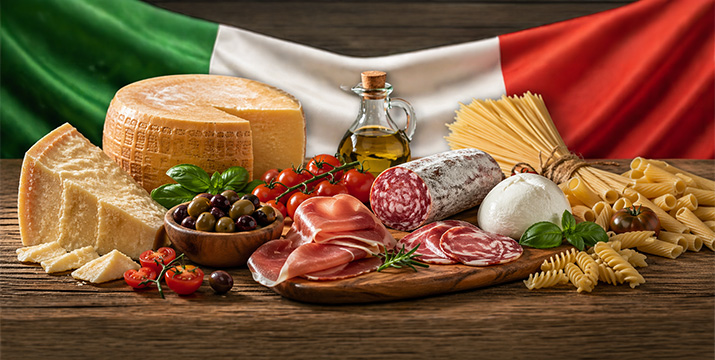
The global value of Italian food
Italian food is one of the most recognized and appreciated cuisines in the world. From cheeses to cured meats, from pasta to ready-made products, the demand for authentic Italian products continues to grow in international markets.
For importers, distributors and retailers, offering Italian products often means positioning themselves in a premium segment, associated with quality, tradition and trust.
However, in today's global market, there is a fundamental question every buyer should ask themselves:
Is the product truly Italian?
Because when authenticity is not guaranteed, Italian origin can quickly transform from an asset into a risk.
The growing problem: italian sounding
Behind the global success of Italian food lies an increasingly widespread phenomenon: italian sounding.
These are products that:
- use Italian names, colors or symbols
- imitate traditional recipes
- create the perception of being Italian
- but are produced outside Italy
Products like "Parmesan", "Mozzarella-style" or sauces with brands evoking Italy but made abroad are widely spread in international markets.
For the end consumer — and sometimes even for buyers — these products may appear authentic. In reality, they often have no connection with Italian origin, traditional production methods or certified quality standards.
How much is the italian sounding phenomenon worth?
Italian sounding is not a marginal phenomenon: it is a global market worth billions.
In some countries, the value of products imitating Italian food actually exceeds that of authentic Italian exports. This creates confusion and makes it increasingly difficult to distinguish between original products and imitations.
For importers and distributors, this means one very concrete thing: the risk of making wrong choices is real.
Why fake Italian products represent a real risk
Choosing non-authentic products is not just a matter of quality — it is a genuine business risk.
- Loss of customer trust
Consumers are increasingly attentive to the origin of products. Selling imitations can undermine trust in the long run.
- Reputational damage
Distributors and retailers risk associating their brand with low-quality or misleading products.
- Regulatory and compliance risks
In many markets, origin labelling is regulated. Incorrect information can lead to legal problems.
- Inconsistent quality
Italian sounding products often cannot guarantee consistency in terms of taste, ingredients and production standards.
Examples of italian sounding products
Understanding the difference between authentic products and imitations is essential.
Here are some typical examples:
- Parmesan vs Parmigiano Reggiano PDO
- Mozzarella-style vs Mozzarella di Bufala Campana PDO
- Generic "Italian pasta" vs pasta actually produced in Italy
- "Italian" sauces produced abroad
These products may look similar, but origin, quality and production processes are completely different.
How to recognise genuine Italian products
For international buyers, knowing how to distinguish authentic products is essential.
Here are the main elements to evaluate:
- Certified origin
Check for certifications such as PDO (DOP) and PGI (IGP).
- Clear labelling
Authentic products clearly indicate the place of production and packaging.
- Traceability
A reliable supplier is able to provide detailed information on the entire supply chain.
- Consistency over time
Quality must be stable and verifiable over time.
Buyer checklist: how to verify authenticity
To reduce risks, it is useful to follow a structured approach:
- Verify the country of origin on the label
- Check for official certifications (PDO, PGI, etc.)
- Request traceability documentation
- Evaluate the supplier's certifications
- Work with structured and reliable partners
This checklist helps avoid costly mistakes and build solid relationships.
The role of certified companies in food trade
One of the most effective ways to reduce risks is to work with a certified food trading company.
Certifications such as IFS Broker ensure that:
- suppliers are selected and monitored
- products comply with rigorous quality and safety standards
- processes are documented and tracked
- risks are managed systematically
A certified partner acts as a genuine quality control filter between production and market.
From product to process: why the partner makes the difference
In international food trade, the difference is not just the product — but the process behind it.
This includes:
- supplier selection
- quality controls
- logistics management
- regulatory compliance
Choosing the right partner means reducing uncertainty and building a reliable supply chain.
Conclusion: Italian origin is an asset — only if it's real
Italian origin is one of the strongest assets in the global food market.
But without verification, it can become a risk.
For importers and distributors, the goal is not simply to purchase Italian products — but to ensure they are authentic, traceable and certified.
Because today, more than ever: authenticity is not just a marketing promise — it is a business requirement.