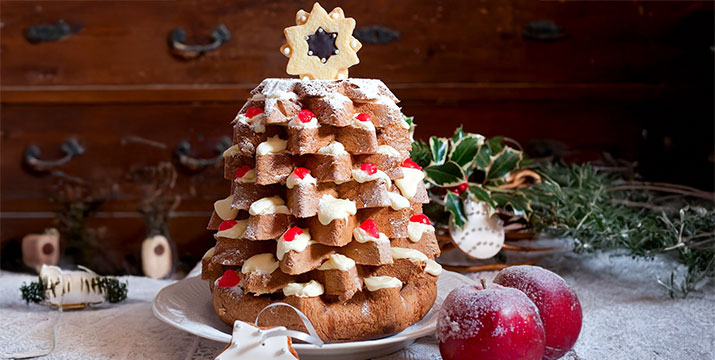


If Christmas means sweets all over the world, in Italy the Christmas period makes us think of panettone and pandoro. Both are important Christmas symbols in Italy, like the Christmas tree or Santa Lucia. And like every respectable symbol, multiple legends are told for both panettone and pandoro. Below is a brief history of these two fantastic Italian sweets and some gourmet recipes to amaze your guests during the holidays!
Panettone and pandoro, what else?
Panettone and pandoro have always been the most loved sweets and not just at Christmas. According to research by Il Sole 24 Ore, it would emerge that these typical Christmas sweets are particularly loved and consumed even in April and even in the middle of summer.
Recognized and loved by customers all over the world, these sweets are the true essence of Christmas. What would Christmas be without them? In this regard, why not fully embrace the Christmas spirit? We suggest a scenario like this: an armchair, a fireplace, good music (not necessarily Christmas music), a glass of tea or sparkling wine and... a slice of panettone or pandoro – typical Italian sweets of this wonderful time of year. Both are important Christmas symbols in Italy, like the Christmas tree or Santa Lucia. And like every respectable symbol, multiple legends are told for both panettone and pandoro...
The history of panettone and its characteristics
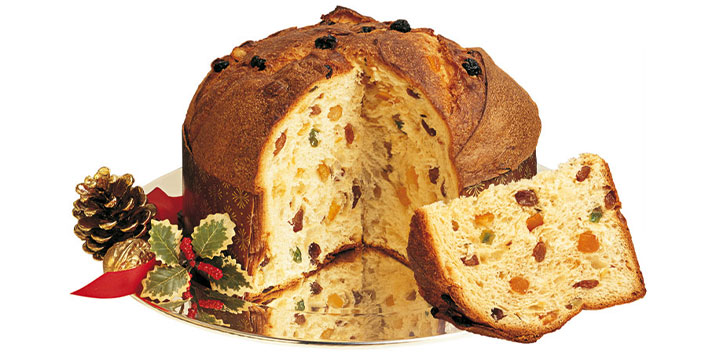
As its name tells, panettone was once a large bread that until the early 1900s was baked without any mold. This was possible because the amount of fat it contained was rather modest; nothing compared to the 6÷700 grams of butter per kilo of flour and the many egg yolks used today by many pastry chefs (if you let a modern panettone rise and bake without a mold, in fact, the result would be a flattened focaccia, not a panettone).
Legend has it that the etymology of the name derives from a certain Toni, hence "Pan del Toni", panettone.
According to this etymological key, Toni, a humble scullion in Ludovico il Moro's kitchen, would be the inventor of one of the most characteristic sweets of Italian tradition. Here's the story: on Christmas Eve, the Sforza chef burns the dessert prepared for the ducal banquet. Toni then decides to sacrifice the sourdough starter he had kept aside for his Christmas. He works it several times with flour, eggs, sugar, raisins and candied fruit, until obtaining a soft and highly leavened dough. The result is a resounding success, which Ludovico il Moro titles Pan de Toni in homage to the creator.
Toni's primacy is not so peaceful; the enterprising scullion disputes it with other creative pastry makers, among whom Ughetto degli Atellani and Suor Ughetta stand out. The place of contention, however, is not history, but the collective imagination: that of Toni and the others are legends conceived between the late nineteenth and early twentieth centuries, to further ennoble what is already the pride of Milanese gastronomy. Ughetto and Ughetta, moreover, are names linked to the word that in Milanese means raisins: ughett.
The true origin of panettone should be sought in the widespread medieval custom of celebrating Christmas with a richer bread than everyday bread. A late fifteenth-century manuscript by Giorgio Valagussa, tutor of the Sforza household, attests to the ducal custom of celebrating the so-called log ritual. On the evening of December 24, a large log was placed in the fireplace and, at the same time, three large wheat breads were brought to the table, a raw material of great value for the time. The head of the family served a slice to all the diners, keeping one for the following year, as a sign of continuity.
Another historical reality also supports the derivation of panettone from the large Christmas wheat bread: until 1395 all the ovens in Milan (except the Rosti bakery, supplier to the wealthiest) had permission to bake wheat bread only at Christmas, to give as a gift to their regular customers. The habit of consuming wheat bread at Christmas, therefore, is very ancient.
The first real definition of a panettone, similar to what we know today, is found in the Cherubini dictionary of 1839, which reads: "A kind of wheat bread adorned with butter, eggs, sugar and raisin (ughett) or sultana grapes". However, we must remember that when the dictionary adds a new "entry" to its pages, the custom has already become established in society, and therefore has now become customary. We can therefore assume that this type of sweet and rich bread was commonly produced for at least thirty, forty years, if not more. Note that Cherubini does not mention yeast.
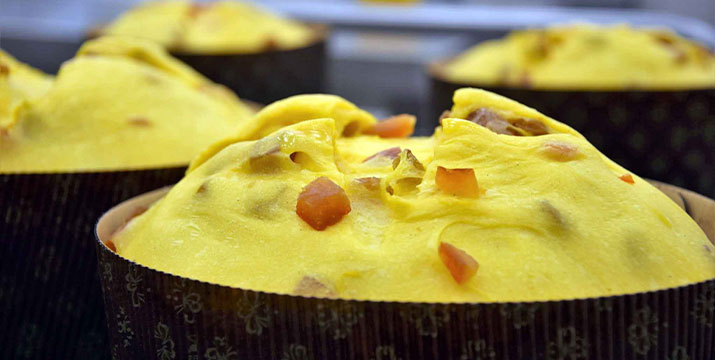
The first recipe that mentions yeast is found in the 1853 book by Giovanni Felice Luraschi entitled "Nuovo cuoco milanese economico". The author speaks of yeast and means natural yeast, that is, a sour paste of water and flour that ferments by itself, usually called "sourdough starter". Still today the only yeast allowed to obtain true panettone. All the recipe books of those times speak of "Milanese-style" panettone and therefore there is no doubt that this sweet was born in Milan.
Source: Scatti di Gusto https://www.scattidigusto.it/2017/12/10/panettone-artigianale-la-ricetta-perfetta-casa/
Today there are very precise rules for a confectionery product to be called "panettone". A ministerial decree of July 22, 2005 in fact establishes the ingredients and characteristics of some traditional Italian sweets including panettone. The classic Milanese must be soft dough and obtained by natural fermentation from sourdough. It must be made with wheat flour, sugar and eggs, but with a higher percentage of yolks than whites. Then raisins, candied citrus peel, butter, natural yeast and salt. Panettone is serious business!
And now let's move on to the history of the other sweet.
The history of pandoro and its characteristics
Pandoro is, together with panettone, one of the most typical and appreciated Italian Christmas sweets not only within national borders but also abroad. The history of pandoro is inextricably linked to the city of Verona as we will see better later.
Source: AIFB https://www.aifb.it/calendario-del-cibo/giornata-nazionale-del-pandoro-verona/
The pandoro recipe is a dive into history. According to some, the origins of the recipe are to be found in Austria, where the so-called "Vienna Bread" was produced, probably derived, in turn, from the French "brioche". According to others, however, it could derive from the "golden bread" that was served on the tables of the richest and oldest noble Venetian families – conical-shaped sweets reserved for them, embellished with gold leaf. Finally, there are those who claim that its birth dates back to 1800, as an evolution of the "Nadalin", a typical Veronese Christmas sweet always star-shaped (but less defined) lower and more compact than pandoro because less leavened. Even sweeter than its famous successor, the Nadalin would precede the pandoro by something like six hundred years because it would have been prepared for the first time in the thirteenth century in honor of the noble Della Scala family who became lords of the city of Verona (in 1232).
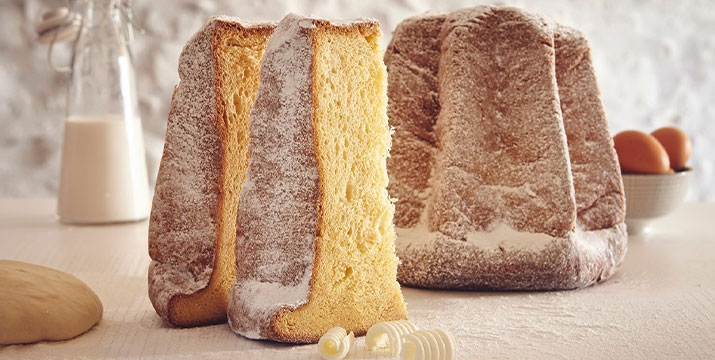
If panettone, or rather the dough of the sweet that will later be called panettone, was known as early as the mid-1500s, the official origins of pandoro date back to the late 1800s thanks to the creativity of the Veronese pastry chef Domenico Melegatti. On October 14, 1894, he filed a patent for a soft sweet with a characteristic eight-pointed star-shaped body, the work of the artist Angelo Dall'Oca Bianca, an impressionist painter. Its success would be lightning-fast. Together with panettone, in fact, it soon became one of the most typical Christmas sweets in Italy. The dough is soft and golden in color due to the presence of eggs, and smells of vanilla. The shape is a truncated cone, with star-shaped reliefs, usually with eight points. Among the ingredients are: flour, sugar, eggs, butter, cocoa butter and yeast.
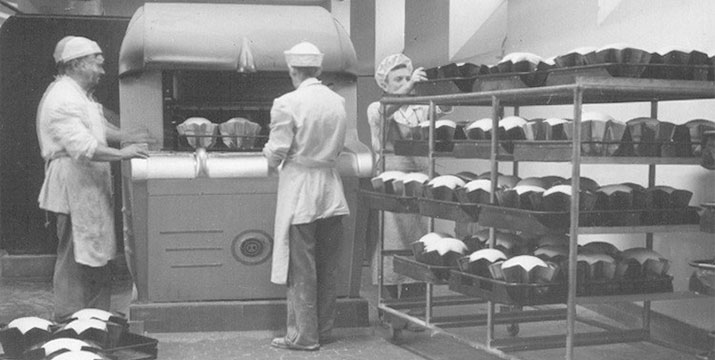
Source: AIFB https://www.aifb.it/calendario-del-cibo/giornata-nazionale-del-pandoro-verona/
The pandoro recipe is prepared respecting a complex technique that consists of many processing phases. Usually pandoro is not garnished internally with creams or candied fruit (like panettone), although over time manufacturers have tried to differentiate their offer. Today in fact, in addition to the traditional recipe there are several variants: chocolate, custard cream, lemon cream and so on, but the classic pandoro, the traditional one, is never filled. Unmissable instead is the sprinkling of vanilla-flavored powdered sugar with which the sweet is served.
After telling the story and legends that distinguish these typical Christmas sweets, we can finally move on to topics closer to our senses.
Both panettone and pandoro can be served in many different and inviting variations, all you need is a little imagination.
Here are some delicious recipes to make truly special Christmas sweets.
Filled and glazed panettone, guaranteed effect!
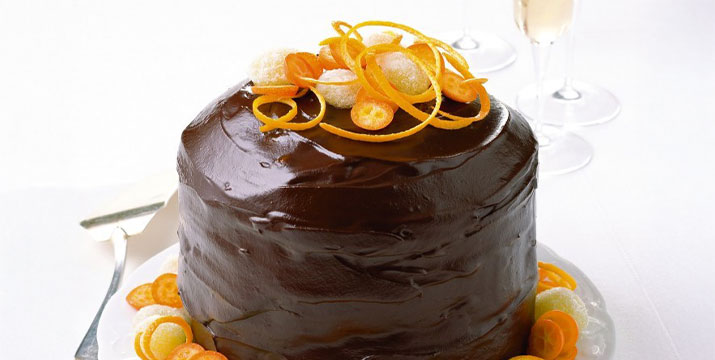
- Empty the panettone. Turn the panettone upside down and cut it with a circular cut, 2 cm from the edge, sinking the knife almost to the bottom. Put it back upright, insert the blade under the cap and move it gently, so as to detach the internal cylinder, without cutting the cap. Turn it over again and pull out the cylinder. Beat the yolks with the sugar until you get a fluffy mixture, add the mascarpone, orange juice and zest and mix until you get a soft cream.
- Fill it. Cut the panettone crumb cylinder, obtaining many discs about 2 cm thick. Distribute some spoonfuls of mascarpone cream on the bottom of the upside-down panettone, place a panettone disc on top, spread it with more cream. Proceed alternating cream and panettone, until closing the panettone with the last crumb disc (the one with the outer crust), compact everything well, pressing it gently with your hands. Wrap the cake in aluminum foil and keep it cool in the refrigerator.
- Prepare the glaze. Melt the chocolate in a bain-marie, pour in the cream and mix until you get a soft glaze. Take the panettone out of the fridge, remove the aluminum and place it on the serving dish, pour the chocolate glaze on top and spread it well with a large spatula. Put the cake back in the fridge.
- A few minutes before serving, decorate it with orange peel, sliced kumquats and, if desired, frosted grapes (dip the berries in lightly beaten egg white, pass them in sugar and let them dry on parchment paper).
Warm panettone tart
- Pour the milk into a saucepan, add the honey and grated orange zest, incorporate the cornstarch, put on the heat and cook until you get a cream, stirring with a whisk.
- Cut the panettone into cubes, collect them in a bowl, pour the cream over them and mix it with a spatula. Beat the egg whites gradually adding the sugar. Mix the yolks into the cream first and, little by little, the egg whites.
- Butter 8 molds with a capacity of about 1.5 dl, sprinkle them with sugar, then pour in the prepared mixture filling them up to 2/3. Place them in a baking tray with a bain-marie and cook in a preheated oven at 180° for about 25 minutes.
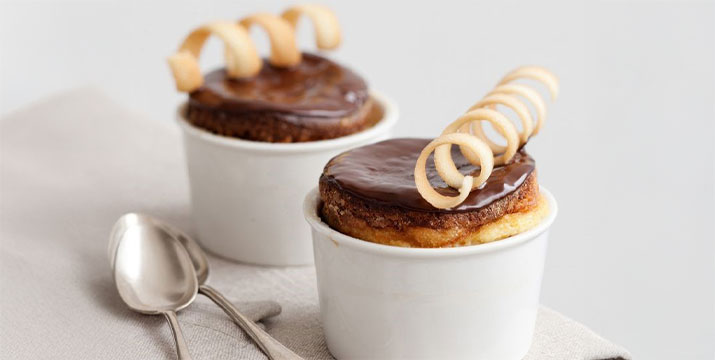
- Prepare the wafer curls: work the butter with the powdered sugar and incorporate the flour alternating it with the egg white; let the mixture drop from a bag with a thin hole, in long strips, on a tray lined with parchment paper; bake at 180° for 3-4 minutes, until they start to brown. Lift them while still hot, one at a time, with a spatula and quickly roll them around the handle of a large wooden spoon, then slide them off.
- Break the chocolate into pieces and melt it in a bain-marie, pour it on a marble surface and spread it in a thin layer with a large spatula.
- Let the chocolate sheet set, then cut out 8 discs. Remove the tarts from the oven, place a chocolate disc on each one which will melt slightly and garnish with a wafer curl
Pandoro Christmas tree
Here is the very easy recipe for the pandoro tree with mascarpone and chocolate cream, a truly spectacular dessert that will win over adults and children!
- Start preparing the mascarpone cream: put 5 egg yolks in a stand mixer and in the meantime take a small saucepan and pour in the water together with 120 gr of granulated sugar. Mix carefully and bring to a temperature of 121°C, using a kitchen thermometer to measure. Before reaching the desired temperature, beat the yolks in the stand mixer. Once you have reached 121°, gradually pour the previously obtained syrup over the yolks and continue beating. Beat until the mixture of ingredients has cooled and in the meantime soften the mascarpone in a bowl with a spoon.
- Now add the beaten yolks to the mascarpone and mix with the help of a spatula, making movements from bottom to top. Cut the pandoro into slices widthwise, break the dark chocolate into pieces and put it in a bain-marie so that it melts completely. Place the base of the pandoro on a serving dish and fill with the mascarpone cream, cover with the second slice of pandoro and repeat the filling until you have reassembled the pandoro. Pour the melted dark chocolate you have melted in a saucepan over the panettone and decorate with a sprinkling of powdered sugar.
We hope that our ideas have encouraged you to try our typical Italian specialties, to make your tables splendid and introduce a touch of novelty alongside traditional dishes.