


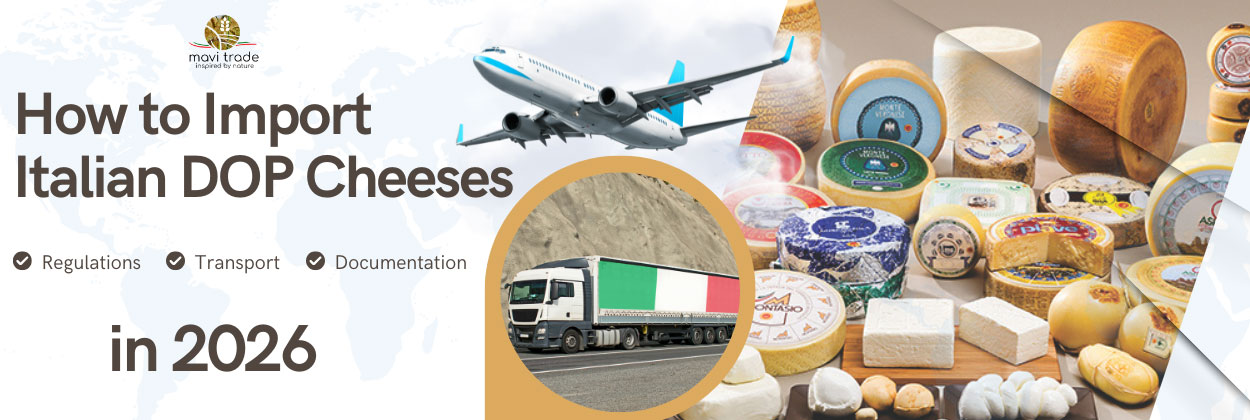
How to Import Italian DOP Cheeses: Regulations, Documentation and Transport in 2026
If you run an Italian restaurant abroad or work as a buyer in the HoReCa channel, you've probably faced this question at some point: how do I get an authentic Parmigiano Reggiano, a certified Grana Padano DOP, or a genuine Pecorino Romano on my tables — reliably, legally, and without surprises at customs?
Importing Italian protected designation cheeses is not complicated, but it requires attention to detail. Regulations change, destination markets have different rules, and a single missing document can hold up an entire shipment. This guide covers everything you need to know in 2026: paperwork, temperatures, labelling, and the differences between EU and non-EU markets.
What 'DOP cheese' means — and why it matters for import
Before entering the bureaucracy, it is worth understanding why DOP cheeses (Protected Designation of Origin) require different handling compared to generic products.
A DOP (Denominazione di Origine Protetta, or Protected Designation of Origin) cheese is regulated under EU Regulation 1151/2012, which guarantees its geographical origin, production method, and organoleptic characteristics. Grana Padano, Parmigiano Reggiano, Pecorino Romano, Asiago, Taleggio: each must comply with a strict production code and pass inspections by a protection consortium before carrying the DOP symbol.
For importers, this means two things:
- From a commercial standpoint, you are buying a product with verifiable and traceable identity — a huge advantage to communicate to your customers.
- From a bureaucratic standpoint, the DOP designation entails additional labelling and documentation requirements compared to common cheeses.
The core documents for every shipment
Regardless of your destination market, these documents are always required.
Commercial Invoice
It must state the value, country of origin (Italy), precise product description with HS code, net and gross weight, and full details of buyer and seller. For DOP cheeses, it's good practice to explicitly name the protected designation and batch number.
Packing List
This document details the physical content of the shipment: number of packages, weight, dimensions and type of packaging. It must match the commercial invoice exactly.
Health Certificate
It is almost always required for non-EU shipments. It is issued by the Italian Ministry of Health and certifies that the product was produced and inspected to EU health standards. The format varies by destination country: the US, Canada, Australia, and Japan each have specific models agreed with Italian authorities.
Certificate of Origin
It is not always mandatory, but is often required by buyers, especially to benefit from reduced tariffs under EU trade agreements (Japan, Canada, South Korea, and others). It is issued by the Italian Chamber of Commerce.
Certificate of Analysis (COA)
This is required by some markets, particularly in Asia. It must be requested from the manufacturer or accredited laboratory by providing a production sample of the individual order.
Temperature and cold chain: what you need to know
Aged hard cheeses like Grana Padano and Parmigiano Reggiano are neither frozen nor fresh in the traditional sense — they tolerate a wider thermal range, but must be protected from temperature swings that damage the paste and rind.
The EU reference regulation is EC Regulation 852/2004 (the Hygiene Package), which requires cold chain integrity throughout transport. In practice:
- Hard aged cheeses (Grana Padano, Parmigiano Reggiano, aged Pecorino): typically transported between +4°C and +12°C, depending on aging and packaging. A whole wheel tolerates fluctuations better than grated or vacuum-packed portions.
- Fresh or soft cheeses: require strictly refrigerated transport at +4°C, in ATP-certified vehicles.
- Packaged grated cheeses: follow manufacturer's instructions, usually between 0°C and +6°C.
For long-distance international shipments — by sea or air — continuous temperature monitoring with dataloggers is essential. An incomplete or missing temperature record can slow down customs clearance significantly, even if the product arrives in perfect condition.
One often underestimated aspect: even if the product arrives in perfect condition, an incomplete or missing temperature report can significantly delay customs clearance or generate disputes from the buyer.
Destination-by-destination guide
The rules change significantly depending on where your restaurant or warehouse is located.
EU internal markets (Germany, France, Spain, Netherlands…)
The simplest scenario: no customs duties, no health certificate per shipment, digital traceability via TRACES. Core documents: invoice, packing list, and DOP-compliant labelling.
United Kingdom
Specific documentation required:
Following the recent 2025 outbreak of LSD (Lumpy Skin Disease), shipments of cheeses such as Grana Padano and Parmigiano Reggiano PDO, which are made from unpasteurized milk, must be accompanied by an official declaration from the producer.
This declaration must specifically state the heat treatment applied to the milk prior to processing, in order to ensure compliance with the sanitary requirements for export.
A single product without proper documents in a shipment can cause the entire cargo to be rejected.
United States
The most complex market bureaucratically, but the largest for Italian export value. All imported cheeses must be cleared through the FDA and, for animal-origin products, the USDA-FSIS. Every Italian production facility must be registered with the FDA under the FSVP programme. Labels must be in English with a US-format Nutrition Facts table. Tariffs on aged cheese can be significant (approximately 17–20%) — always verify the current rate before each shipment, as they are subject to political changes.
Canada
Canada operates a Tariff Rate Quota (TRQ) system for imported cheeses. Out-of-quota tariffs can be very high. Work with a local importer who has quota access, or operate under the CETA (EU-Canada trade agreement), which provides preferential conditions for many European DOP products. Labelling must be bilingual (English and French).
Australia
Strict biosecurity controls apply. Hard aged cheeses are generally admitted, but early shipments to a new importer will face frequent inspections under the Imported Food Inspection Scheme (IFIS). Inspection frequency decreases after a series of compliant shipments. Labels must include legal product name, ingredients, allergens, batch number, expiry date, origin indication, and Australian importer details.
Japan, South Korea, China
Fast-growing markets for Italian cheeses. Each country has specific and often detailed health and labelling requirements. Japan requires a health certificate on a Japan-specific model. China requires the exporting facility to be registered in the GACC (General Administration of Customs of China). For all three, working with a local importer or customs broker with specific experience is strongly recommended.
What to ask your supplier
A well-organised supplier makes the difference between a smooth shipment and one stuck at customs. When choosing your Italian DOP cheese partner, make sure they can provide:
- Complete documentation tailored to your specific destination market — not generic certificates.
- Full traceability: batch number, producing dairy, packaging date.
- Quality certifications: the IFS Broker certification, for instance, guarantees that the food broker manages procurement, sales and logistics processes according to internationally recognised standards.
A structured supplier must also be able to answer clearly: is this product allowed in my country? Which documentation is needed for arrival customs? Do delivery times fit the remaining shelf life I need?
Shelf life: calculate before you order
For aged cheeses, shelf life varies significantly depending on the format:
- Whole wheels: can last months under correct conditions, but once the rind is cut, shelf life decreases rapidly.
- Vacuum-packed portions: the shelf life on the label is binding; calculate it against shipping and customs clearance time.
- Packaged grated cheese: typically 6 months sealed, much shorter once opened.
The practical rule for a restaurant ordering monthly: order a quantity you can sell through within half the remaining shelf life at point of reception. This gives you buffer for unexpected logistical delays and ensures the product reaches your customer in optimal condition.
Conclusion
Importing Italian DOP cheeses requires care, but every compliance step exists for a reason: to guarantee that what arrives in your kitchen is authentic, safe and fully traceable. That's the same guarantee you pass on to your customers when you write 'Grana Padano DOP' on your menu — and what sets your offer apart from anyone using uncertified or imitation products.
If you're looking for a reliable partner for Italian aged DOP cheeses for your restaurant or distribution business, Ma-Vi Trade specialises in B2B export of certified Italian DOP products, with BRC and IFS Broker certification. Contact us for a consultation tailored to your destination and volume needs.
Published June 2026. Customs and health regulations are subject to frequent updates — always verify current requirements with your freight forwarder or local importer before shipping.