


Two Italian Cheeses with Protected Designation of Origin. What does PDO mean? The term refers to the characteristics of typicality. Choose Grana Padano or Parmigiano Reggiano? It depends.
What unites and differentiates Grana Padano and Parmigiano Reggiano?
These cheeses are the result of tradition and specific territorial and climatic peculiarities of an area. In addition, production is bound by a precise quality standard, derived from the nature of the raw materials used and rigorous and guaranteed processing processes.
The Protected Designation of Origin (PDO) is the European recognition that designates an agricultural or food product whose entire production cycle, from raw material to finished product, takes place in a well-defined geographical area that cannot be reproduced elsewhere. This strong relationship is guaranteed by a production specification, i.e. a code of self-discipline whose compliance by operators is controlled by a recognized third-party body appointed by the Ministry of Agricultural and Forestry Policies. This ensures the actual authenticity of a PDO product.
Although they are both hard cheeses, they have differences related to topics such as: production area, livestock feeding, raw material processing and aging. Let's first see the common points and then the differences.
What unites Grana Padano and Parmigiano Reggiano:
- Long aging
- Hard paste
- PDO
Differences between Grana Padano and Parmigiano Reggiano:
| Characteristic | Grana Padano | Parmigiano Reggiano |
|---|---|---|
| Production area | 5 regions of Northern Italy | only in Emilia-Romagna |
| Feeding | use of silage which is obtained from the whole cereal plant which is shredded and stored in silos | Only grass from the area where the cheese is produced |
| Processing | 2 times a day from partial skimming by natural cream rising | 1 time a day; the milk from the evening milking rests until the morning when it is integrated with the whole milk from the morning milking |
| Preservatives | Lysozyme, a natural protein extracted from eggs | no preservatives |
| Aging | ready after 9 months up to 24 months of aging | ready after at least 12 months up to 36 months and beyond of aging |
Both are two Italian cheeses of excellence, famous all over the world, widespread and produced throughout Northern Italy. Although they have similar organoleptic characteristics, they are distinguished by their flavor. That of Parmigiano Reggiano is more complex, and evolves over time: up to 12 months you can still predominantly taste the milk, as the aging progresses notes of citrus, dried fruit, and hazelnuts emerge. Grana Padano, on the other hand, is creamier, melting, and recalls the characteristics of broth.
How to cut a wheel of Parmigiano Reggiano and Grana Padano?
The best thing is to watch the following video:
How much Parmigiano Reggiano and Grana Padano is sold outside Italy?
Mainly used to season first courses, they have very similar sales volumes. The slight prevalence of Grana Padano, in Italy and abroad, is also due to an economic factor: it costs a little less than Parmigiano Reggiano. The latter is also produced in a more limited area: if Grana is processed in 5 regions: Piedmont, Lombardy, Trentino Alto Adige, Emilia Romagna and Veneto, Parmigiano is mainly produced in one region (Emilia Romagna) in the provinces of Mantua, Reggio Emilia, Bologna, Parma and Modena.
In the last three years (2017 - 2019), the production of Parmigiano Reggiano increased from 3.47 million wheels to 3.75 million wheels, registering a growth of 8.1%. Italy today represents just under 60% of the total, against an export share of 41%!
Grana Padano turned out to be, in 2019, the most consumed hard cheese (cow's milk) in Italy. The growth of exports drives the sales of the PDO. In particular, EU countries shine where an increase of 17% is noted (Germany is the first country after Italy). In 2019, 5,164,759 wheels were produced. Of these, about 2 million, or 41% of the total, were exported.
What cheese is Parmesan?
Abroad they are often identified as "Parmesan", a generic term that distinguishes a hard grated cheese, but if you want to be sure that you are buying or consuming an authentic product you must make sure that on the packaging is written Parmigiano Reggiano or Grana Padano and next to these names is the symbol of the individual PDOs.


Our company is part of the Grana Padano Piacentino business network and especially promotes cheese produced in our lands.
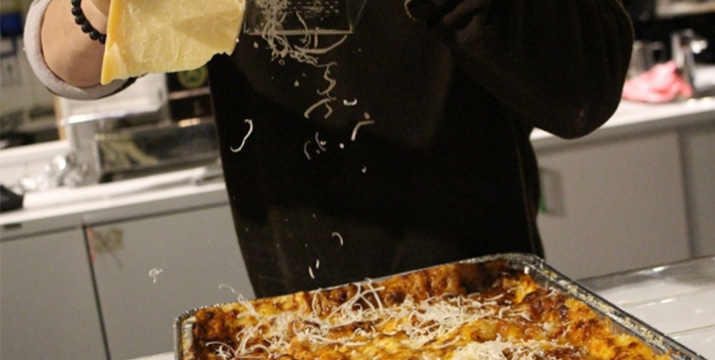
Both Grana Padano and Parmigiano Reggiano are mainly used grated to season first courses and give them more creaminess: but let's not limit ourselves to a sprinkling on pasta or rice! Both of these cheeses can be excellent ingredients for various recipes not only savory but also sweet, in unusual and refined combinations.
They are healthy cheeses, providers of fundamental nutrients in the growth phases of children and adolescents, essential in the diet of athletes.
Try them to prepare delicious appetizers, accompanied with cured meats and a dry white wine or with aromatic sauces based on black olives, tomato and basil or green sauces. They are perfect for softening all types of fillings! In summer, by adding petals of Grana Padano or Parmigiano Reggiano on fresh salads you will make them much more nutritious and with the addition of balsamic vinegar they are really appetizing!